

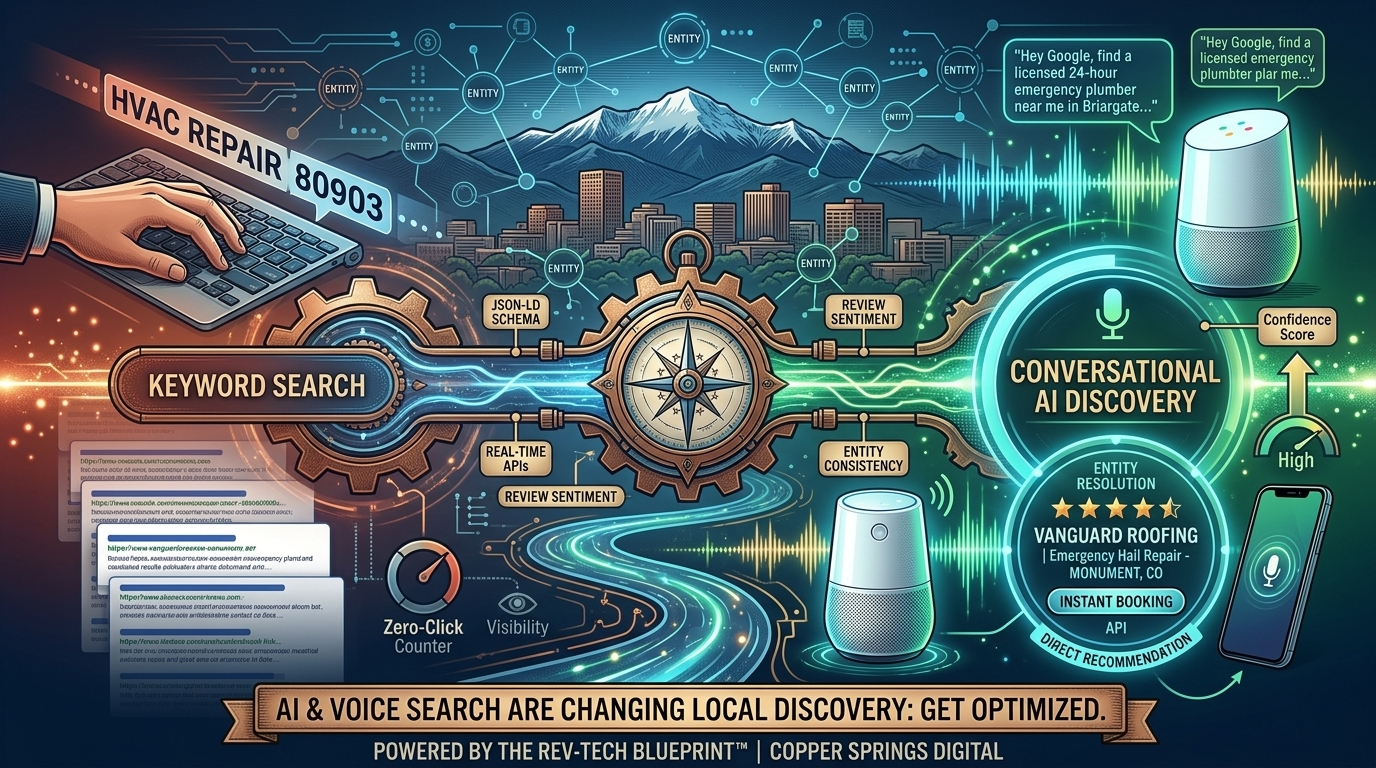
The way prospective clients and customers discover local service businesses in Colorado Springs has undergone a fundamental transformation.
For nearly two decades, local search followed a predictable user behavior pattern: a customer sat down at a computer or opened a smartphone browser, typed a fragmented keyword like “dentist Colorado Springs” or “plumber 80920”, scanned a list of ten blue links or three map pins, and manually clicked through several websites to compare phone numbers, business hours, and service lists.
That era is officially behind us.
Today, local search is driven by conversational AI engines, AI Overviews, generative search experiences, and natural language voice queries across smartphones, smart home devices, and connected vehicles. When a homeowner in Briargate experiences an emergency pipe burst at 6:00 AM, they don’t type keywords into a box—they speak directly to their device:
“Hey Google, find a licensed 24-hour emergency plumber near me who handles frozen pipe repair and can get here in under an hour.”
Instead of delivering a page of static links for the user to sift through, AI search systems process the full context of that complex query, evaluate structured business data across the web, synthesize verified customer reviews, and deliver a single, direct recommendation.
At Copper Springs Digital, we engineer local digital infrastructure using our Rev-Tech Blueprint™ to ensure Front Range businesses aren’t just optimized for traditional search engines, but are deeply embedded into the AI ecosystem.
Below is an executive guide for business owners and practice managers on how AI and voice search are redefining local discovery, and the exact steps required to future-proof your digital presence.
The Paradigm Shift: From Keyword Indexing to Conversational Entity Resolution
To understand why traditional SEO strategies are losing ground, it is necessary to examine how search engines evolved from basic keyword matching to conversational entity resolution.
TRADITIONAL KEYWORD SEARCH (OLD)
Query: "HVAC repair 80920"
   │
   ├──> Matches exact text strings on web pages
   └──> Returns 10 blue links + Map Pack (User does the evaluation work)

AI & VOICE SEARCH EXPERIENCES (2026)
Query: "Who is the top-rated furnace technician near me in Briargate that offers same-day emergency repairs and financing?"
   │
   ├──> Natural Language Processing (NLP) parses intent & entities
   ├──> Cross-checks real-time JSON-LD Schema, reviews, & live booking APIs
   └──> Synthesizes & speaks a SINGLE, trusted recommendation + instant booking action
1. Keyword Strings vs. Conversational Long-Tail Intent
Traditional search optimization focused heavily on exact-match keywords embedded into website headings and copy. AI and voice search systems, powered by advanced Natural Language Processing (NLP), interpret entire natural language phrases, conversational nuances, implicit locations, and conditional parameters (“open now”, “offers financing”, “handles commercial flat roofs”).
2. Search Engine Results Pages (SERPs) vs. Zero-Click Direct Answers
In traditional search, getting onto page one guaranteed a steady trickle of website traffic. In an AI-driven discovery landscape, Zero-Click Searches dominate. AI engines summarize information directly on the response screen or read it aloud via voice assistants. If your business infrastructure isn’t formatted for instant AI extraction, your company simply won’t be mentioned in the answer.
3. Web Pages vs. Connected “Knowledge Entities”
AI models do not look at your website as a standalone document; they view your business as a Knowledge Entity within a broader digital graph. The AI cross-references your website’s structured data with your Google Business Profile, local directory citations, verified third-party reviews, licensing boards, and operational APIs to confirm your identity, geographic boundary, real-time availability, and trustworthiness.
4 Core Technological Drivers Behind AI Local Search
To dominate local search, local service businesses must understand the four technical pillars powering AI and voice discovery:
+-------------------------------------------------------------------------+
|                  THE AI LOCAL DISCOVERY ECOSYSTEM                       |
+-------------------------------------------------------------------------+
|  1. JSON-LD SCHEMA MARKUP  -> Explicit structured data reading for AI   |
|                                web crawlers.                            |
|  2. REVIEW SYNTHESIS       -> Natural language sentiment & topic        |
|                                extraction from customer reviews.        |
|  3. REAL-TIME DATA APIs    -> Live sync for availability, scheduling,   |
|                                and emergency service statuses.          |
|  4. ENTITY AUTHORITIES     -> Unanimous NAP data across Front Range     |
|                                directories & local government sites.    |
+-------------------------------------------------------------------------+
1. Advanced JSON-LD Schema Markup (Structured Data)
AI crawlers do not read web pages like human beings; they parse code looking for explicit, structured relationships. JSON-LD Schema Markup is the machine-readable translation layer of your website.
When an AI engine evaluates your business, it looks for schema properties that define:
- @type: Specific entity definitions (
MedicalBusiness,LegalService,HVACBusiness,RoofingContractor). - geoCoordinates: Exact latitude and longitude parameters down to the physical address.
- areaServed: Explicitly defined neighborhood boundaries (e.g., Briargate, Rockrimmon, Broadmoor, Monument, Falcon).
- hasOfferCatalog: Structured lists of specific services, pricing models, and warranties offered.
- openingHoursSpecification: Real-time operating parameters, including holiday schedules and emergency service availability.
Without schema markup, an AI engine must “guess” what your business does by scanning unstructured text—and AI models are trained to prioritize explicit, verifiable data over guesswork.
2. Semantic Review Sentiment Extraction
Voice assistants and AI models do not just count your total number of reviews or calculate your average star rating; they perform deep sentiment analysis on the actual text content written by your clients.
If twenty customers leave reviews containing phrases like “They fixed our furnace on a Sunday in Black Forest” or “Great personal injury lawyer for auto accidents in El Paso County”, the AI maps those specific service-location combinations directly to your entity profile.
When a voice user asks for a recommendation matching those parameters, the AI pulls from that verified sentiment database to substantiate its answer:
“I recommend Vanguard Roofing. Customers frequently highlight their fast hail damage inspections and seamless insurance claims process in Colorado Springs.”
3. Real-Time Operational API Connectivity
Static information is no longer sufficient. AI assistants aim to solve problems end-to-end. If a voice search query asks to “book an appointment with a cosmetic dentist near me for tomorrow morning”, the AI prioritizes practice listings that expose real-time booking availability via open API integrations or structured booking widgets over practices that rely on passive contact forms.
4. Unanimous Entity Consistency Across the Front Range
If your business name, address, or phone number varies across the web, or if your operating hours on Apple Maps contradict your Google Business Profile, AI models register an “entity confidence discrepancy.” To avoid recommending an inactive or inaccurate business to a voice search user, the AI skips listings with low confidence scores in favor of businesses with 100% data alignment.
How to Optimize Your Business for AI & Voice Search: The Rev-Tech Framework
At Copper Springs Digital, we don’t rely on outdated SEO techniques. Our Rev-Tech Blueprint™ systematically upgrades your digital assets to ensure complete compatibility with AI search engines, voice assistants, and generative discovery platforms.
Below is the strategic implementation blueprint to capture voice search intent and AI recommendations in Colorado Springs.
Step 1: Re-Architect Content Using Natural Language FAQs
Voice queries are naturally longer, question-based, and conversational. People rarely speak in fragmented keywords.
To capture this conversational traffic, your website architecture must incorporate structured FAQ Modules on every core service and location landing page.
Traditional Keyword Optimization vs. Voice/AI-First FAQ Architecture
- Traditional Keyword Target:
Dental Implants Colorado Springs - Voice/AI-Optimized FAQ Target:
How much do single-tooth dental implants cost in Colorado Springs, and does insurance cover them?
How to Structure FAQ Content for AI Feature Snippets:
- Ask the Exact Question: Format the heading (
###or<h2>) as a complete, conversational question that a customer would speak aloud to a voice assistant. - Provide a Direct 2-Sentence Answer: Start the paragraph immediately following the heading with a concise, direct answer (30–50 words). AI models extract this exact text block to read aloud as the primary voice answer.
- Elaborate with Structured Data: Follow the concise answer with bullet points, pricing breakdowns, or technical details, and wrap the entire section in formal
FAQPageschema markup.
Step 2: Implement Complete Nested Local Schema Infrastructure
To give AI search models total certainty regarding your business capabilities, implement a nested JSON-LD schema footprint directly into the header of your website.
Here is a conceptual breakdown of the schema architecture required for an HVAC company operating in Colorado Springs:
JSON
{
  "@context": "https://schema.org",
  "@type": "HVACBusiness",
  "name": "Apex Heating & Air Conditioning",
  "image": "https://copperspringsdigital.com/assets/apex-logo.jpg",
  "@id": "https://copperspringsdigital.com/#organization",
  "url": "https://copperspringsdigital.com",
  "telephone": "+1-719-555-0199",
  "priceRange": "$$",
  "address": {
    "@type": "PostalAddress",
    "streetAddress": "123 Pikes Peak Ave",
    "addressLocality": "Colorado Springs",
    "addressRegion": "CO",
    "postalCode": "80903",
    "addressCountry": "US"
  },
  "geo": {
    "@type": "GeoCoordinates",
    "latitude": 38.833882,
    "longitude": -104.821363
  },
  "areaServed": [
    { "@type": "City", "name": "Colorado Springs" },
    { "@type": "AdministrativeArea", "name": "Briargate" },
    { "@type": "AdministrativeArea", "name": "Broadmoor" },
    { "@type": "City", "name": "Monument" }
  ],
  "hasOfferCatalog": {
    "@type": "OfferCatalog",
    "name": "HVAC Services",
    "itemListElement": [
      {
        "@type": "Offer",
        "itemOffered": {
          "@type": "Service",
          "name": "24/7 Emergency Furnace Repair"
        }
      }
    ]
  }
}
By embedding structured code like this, you eliminate all ambiguity for AI engines crawling your platform.
Step 3: Train Customer Reviews to Include Conversational Keywords
Because AI sentiment analysis relies heavily on client review text, you must systematically encourage clients to leave detailed, descriptive feedback that mentions specific services and local geographic markers.
The Passive Review Request (Low AI Value)
“Thanks for choosing us! Please leave us a review on Google.”
- Customer Result: “Great company! Very friendly staff. 5 stars!” (Zero service or location entities for AI to extract).
The AI-Optimized Review Workflow (High AI Value)
“Thanks for choosing Apex Heating & Air! When leaving your Google review, would you mind mentioning the specific service we provided today (like furnace repair or AC installation) and what neighborhood in Colorado Springs we visited?”
- Customer Result: “Apex came out to our home in Briargate on short notice and performed an emergency furnace repair before the snowstorm hit. Highly recommend their HVAC team!” (Rich in entities, location markers, and service parameters).
Step 4: Claim & Synchronize Profiles Across the Voice Assistant Ecosystem
Different voice assistants pull local business data from distinct mapping and directory sources. To ensure your business is recommended regardless of which device or operating system a prospect uses, your business entity data must be fully optimized across all major underlying platforms:
  SIRI (Apple)          --->  Apple Business Connect & Apple Maps
  GOOGLE ASSISTANT      --->  Google Business Profile & Google Maps
  ALEXA (Amazon)        --->  Yelp, Bing Places, & Yext Data Layer
  CHATGPT / PERPLEXITY  --->  Open Web Index, Schema Markup, & Citations
- Apple Business Connect: Optimizes recommendations for Siri, Apple Maps, and iPhone users. Ensure your cover photo, service lists, action buttons (“Book Now”), and physical location pins are explicitly claimed and verified.
- Google Business Profile: Serves as the primary data pipeline for Google Assistant, Gemini, Google Maps, and AI Overviews.
- Bing Places for Business: Supplies local data to Amazon Alexa devices, Microsoft Copilot, and Cortana systems.
- Yelp & Directory Aggregators: Amazon Alexa relies heavily on Yelp data to deliver local service provider details and review ratings.
Action Plan: Preparing Your Business for the AI-First Future
The shift to AI and voice search is not a distant trend—it is actively reshaping how local customers make buying decisions along the Front Range today. Business owners who rely solely on legacy SEO practices risk becoming invisible as conversational search engines take over.
Use this 4-week transition checklist to align your local business with AI discovery standards:
| Timeline | Strategic Focus | Execution Deliverables |
| Week 1 | Entity & Citation Clean-Up | Standardize NAP data across Google, Apple Maps, Bing, and major directory networks. Eliminate all duplicate listings. |
| Week 2 | Technical Schema Deployment | Inject custom JSON-LD schema markup (LocalBusiness, GeoCoordinates, Services, FAQs) into your website code. |
| Week 3 | Conversational FAQ Integration | Re-architect service pages with direct, natural language FAQ blocks formatted for AI voice snippet extraction. |
| Week 4 | Review Engine Calibration | Deploy automated post-service SMS workflows prompting clients to detail specific services and local neighborhood names in reviews. |
Build an AI-Proof Digital Footprint with Copper Springs Digital
Navigating the transition from traditional search engines to conversational AI requires technical precision, modern web architecture, and deep local market experience.
At Copper Springs Digital, we don’t just optimize websites for keywords; we build future-proof digital infrastructure that establishes your business as an undisputed authority across Google, Apple, AI search engines, and voice assistant networks.
Is Your Local Business Visible to AI Search Engines?
Contact our team today to request a comprehensive AI & Voice Search Discovery Audit and learn how the Rev-Tech Blueprint™ can position your business at the forefront of local discovery across Colorado Springs and the Front Range.